Top 8 IPRoyal Alternatives in 2026
Try for $1.99 Try 300 MB of residential traffic. It never expires.

Contents 9 sections
The residential proxy market has changed dramatically over the past two years. If back in 2023 arbitrageurs and parsers could get by with basic solutions like IPRoyal, today the requirements have grown many times over. Platforms have learned to detect even quality residential IPs if they don't have a clean enough history or weak rotation.
IPRoyal has long been a decent choice for beginners. Affordable prices, simple interface. But there's one problem that everyone who works with this service for more than a month faces. Traffic expires. You bought 50 gigabytes for a month, used 20, and the rest disappeared. For those who run campaigns in waves or farm accounts seasonally, this turns into a serious expense item.
Over three years of working with dozens of proxy providers, we've tested practically the entire market. We've gathered alternatives that actually work in the field. From Facebook arbitrage to e-commerce platform parsing. We evaluated each service by criteria that matter to professionals. IP cleanliness, session stability, settings flexibility and, critically, usage economics.
At a glance
| Provider | Price per GB | Traffic | Min. payment | IP pool | Verification | Clean IPs |
|---|---|---|---|---|---|---|
| GonzoProxy us | from $0.70/GB | never expires | $13 | 20.6M | not required | 95% |
| SOAX | from $1.65/GB | 60 days | no data | no data | required | 37% |
| Mango Proxy | from $3/GB | no data | $100 | 15M | not required | 38% |
| Nexus Proxy | from $4/GB | no data | no data | no data | no data | 36% |
| Decodo (formerly Smartproxy) | from $7/GB | no data | $50 | 40M | not required | 31% |
1. GonzoProxy
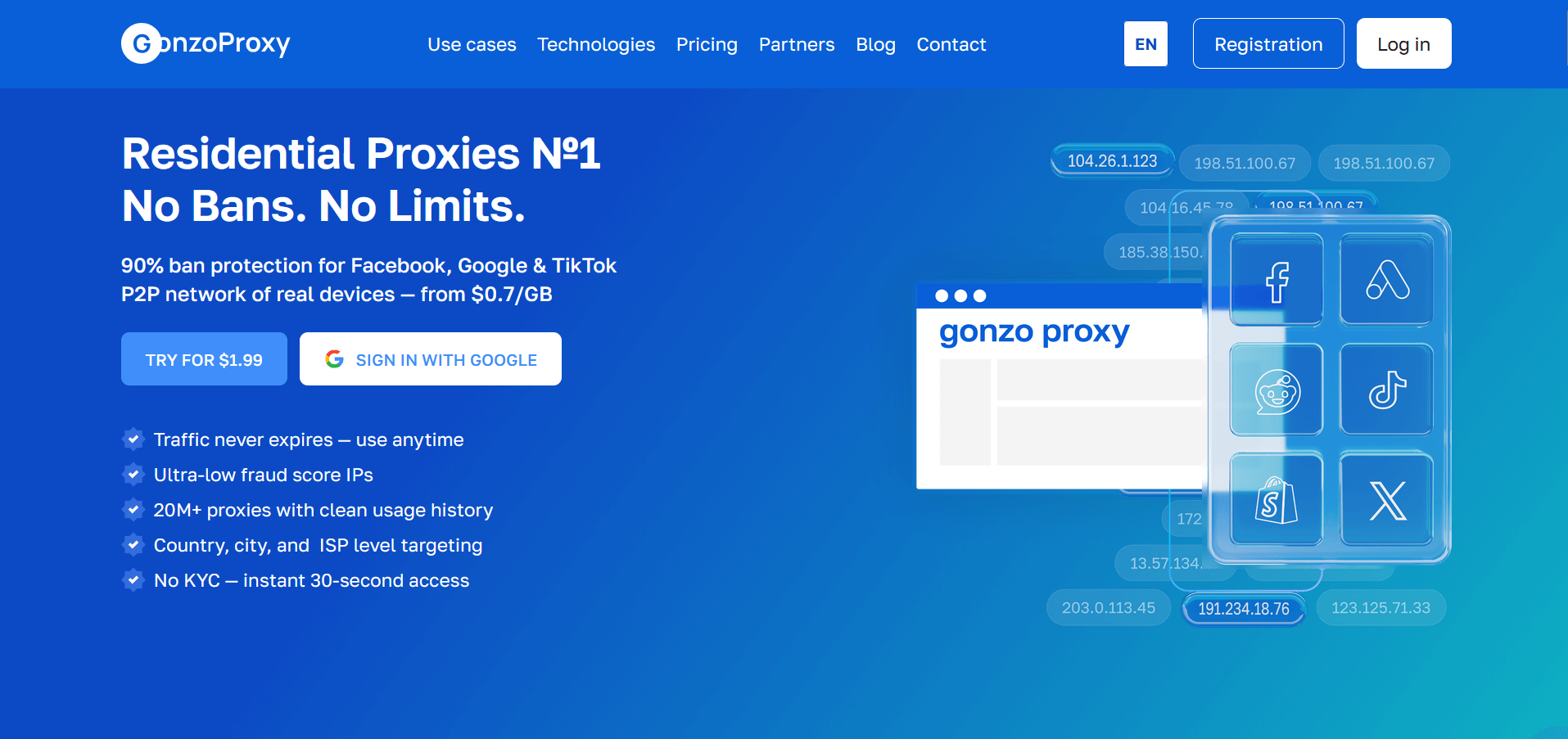
GonzoProxy is built on P2P technology with a pool of over 20 million real devices. This isn't a resale of someone else's pool, like most providers have, but our own infrastructure. The company is officially registered in the UK (GonzoProxy LTD) and has been on the market for three years already.
The main difference from IPRoyal and other competitors is in the principle of working with traffic. You buy gigabytes once, and they stay on your balance forever. Didn't use them this month, use them next month or in six months. For teams that work in waves or seasonally, the savings reach up to 40% just from this alone.
From our experience, here's an example. A team of eight media buyers purchased 500 GB in January to launch campaigns. They actively ran traffic in February-March, then the project paused until June. They came back, and all the traffic was there, nothing had expired. With IPRoyal they would have had to buy again.
Proxy Types
The service offers two main types:
- Dynamic residential proxies. IPs from a P2P network of real home connections. The sticky session mechanism works for up to 72 hours, keeping the IP as long as possible. If the donor device disconnects, the system automatically selects a similar IP based on specified parameters (city, provider). Create even a thousand proxies for free, pay only for used traffic.
- Mobile traffic is billed per gigabyte, from $7.50 down to $4 per GB depending on volume. Purchased traffic never expires.Mobile traffic is billed per gigabyte, from $7.50 down to $4 per GB depending on volume. Purchased traffic never expires. You can use one proxy for multiple accounts, just changing the IP through the panel with one click. Each change gives a new unique mobile address. Currently available in Ukraine and Poland, other countries are being added.
Key Features
- No KYC system. No documents, passports, selfies with paper. Login through Google, get access in 30 seconds. For 95% of platforms this is enough. Verification is only needed if you work with financial services or government portals.
- Precise geo-targeting at no extra cost. You choose country, city and specific internet service provider (ISP) for free. With most competitors, provider selection costs extra money or isn't available at all. For advertising accounts this is critical. You can select an IP from the same provider as your target audience.
- Low fraud score. IPs go through multi-level filtering. The system automatically filters out addresses with blocks and bad history. Up to 90% of addresses have a fraud score below 0.1, which provides 90% protection from bans on Facebook, Google and TikTok.
- 24/7 Telegram support. Real people respond within 5 minutes, not bots or ticket systems. They'll help set up, select optimal parameters for your task, quickly replace proxies if something goes wrong.
Pros and Cons
Pros
- Traffic never expires. The only service on the market with unlimited storage
- Unlimited proxy creation for free. Pay only for gigabytes used
- Official UK registration. You work with a real company, not an anonymous provider
- Enterprise-level stability
Cons
- Mobile proxies currently only in two countries (though actively expanding geography)
- No operator selection for mobile proxies
Ideal Use Cases
- Traffic arbitrage and media buying. Managing dozens or hundreds of Facebook Ads and Google Ads advertising accounts. Low IP fraud score provides moderation pass-through, sticky sessions up to 72 hours ensure account stability. The "1 proxy = 1 account" scheme works perfectly.
- Social media farming. TikTok, Instagram, Reddit, Twitter, OnlyFans for any platforms where uniqueness of each account is needed. Create a thousand proxies with city targeting, pay only for traffic you actually used.
- Parsing and scraping. Data collection from e-commerce platforms, competitor price monitoring, SERP analysis. IP rotation on demand or by timer, automatic replacement of problematic addresses. For large-scale parsing, launch several proxies in parallel.
- E-commerce automation. Purchasing limited items through bots, working with marketplaces, multiple accounts on eBay/Amazon. Different IPs from one city create natural buyer behavior.
Pricing
Hybrid pricing model. Proxy creation is free, payment only for traffic.
Price scale (the more you get, the cheaper):
- 1-24 GB: $6.5/GB
- 25-49 GB: $5.5/GB
- 50-99 GB: $4.5/GB
- 100-249 GB: $3.9/GB
- 250-499 GB: $3.2/GB
- 500-999 GB: $2.75/GB
- 1000+ GB: from $2.0/GB
Mobile traffic is billed per gigabyte, from $7.50 down to $4 per GB depending on volume. Purchased traffic never expires.
2. SOAX
SOAX positions itself as a premium provider focused on IP rotation. The company has been operating since 2019, headquarters in Estonia. Pool claimed at 8.5 million addresses.
The interface is clear, there are flexible rotation settings. But there's a nuance that shows up with active use. Speed can drop during peak hours. For European and American geos this is especially noticeable in the evening local time.
Proxy Types
They offer residential, mobile and datacenter proxies. Residential work through rotation, you can set session time from 2 to 120 minutes. Mobile available in a limited number of countries.
Key Features
Advanced control panel with detailed statistics. API for integration. Geolocation selection down to city level. Automatic rotation by timer or on demand.
Pros and Cons
Pros
- Good control panel
- Flexible rotation settings
- Support responds during business hours
Cons
- Traffic expires every month
- High prices from $6.60 per GB
- Speed drops during peak hours
- Sometimes IPs are already burned
Ideal Use Cases
Suitable for small projects where IP rotation is important and price isn't critical. For medium complexity site scraping.
Pricing
Starting plan from $99 for 15 GB. Traffic valid for 30 days, then expires. No trial period, minimum payment $99.
3. 911 Proxy (911 S5)
911 Proxy was popular a few years ago, especially in the Chinese and Asian environment. But in 2022 the service shut down after problems with law enforcement. Now several clones of questionable quality operate under this brand.
We don't recommend considering this option seriously. The original service is dead, the new versions are attempts to profit from brand recognition.
Proxy Types
SOCKS5 proxies with a large pool are claimed. The real quality and origin of IPs is questionable.
Key Features
Low prices, large claimed address pool. In reality, high risk of getting compromised IPs.
Pros and Cons
Pros
- Conditionally low prices
Cons
- Original service is closed
- Clones are unreliable
- High risk of legal problems
- Support is practically absent
- Unclear IP origin
Ideal Use Cases
Not recommended for commercial use.
Pricing
Prices vary depending on the clone. Usually no trial periods.
4. Mango Proxy
Relatively new market player, main focus on Asian region. Pool claimed around 70 million IPs, but testing showed uneven quality.
From a conversation with their manager at a conference, it became known that the main clients are bot operators. Mass action emulation, view inflation, device farms from China, India, Pakistan. For serious arbitrage or working with Western platforms, this isn't the most reliable choice.
Proxy Types
Residential and mobile proxies. Static residential addresses available. Geography is wide, but IP quality varies greatly across countries.
Key Features
Large claimed pool. Relatively low prices. API for automation.
Pros and Cons
Pros
- Wide geography
- Affordable prices
Cons
- IP quality is uneven
- Main client base is bot operators and inflators
- High fraud score on part of addresses
- Traffic expires monthly
- Support works slowly
Ideal Use Cases
May work for undemanding tasks in Asian geos. For working with Facebook, Google, TikTok, better to look toward higher quality providers.
Pricing
From $3/GB, but traffic only valid for a month. Minimum payment from $100.
5. Nexus Proxy
Nexus Proxy specializes in mobile proxies for the USA. Pool is relatively small, but the company focuses on quality rather than quantity.
When working with American social networks and platforms, they show good results. However, limited geography makes them a highly specialized solution.
Proxy Types
Mainly US mobile proxies. There are several European directions, but the selection is modest.
Key Features
Quality mobile IPs for USA. Simple interface. Fast address changes.
Pros and Cons
Pros
- Good IP quality for USA
- Fast rotation
- Stable operation
Cons
- Very limited geography
- High prices
- Traffic expires monthly
- No residential proxies in the broad sense
Ideal Use Cases
Working with American traffic, US-based social networks and platforms. If you only need mobile IPs for the States.
Pricing
From $80/month for 40 GB mobile traffic. Traffic expires after a month. 3-day trial period with first month payment.
6. Decodo (formerly Smartproxy)
Smartproxy rebranded to Decodo in 2024. One of the market veterans, operating since 2018. Large address pool, developed infrastructure. Positioned as a universal solution.
After rebranding, they changed pricing policy not for the better. Minimum entry threshold increased, and flexibility decreased.
Proxy Types
Residential, datacenter, mobile proxies. ISP proxies available (hybrid of residential and datacenter).
Key Features
Wide geography, large pool. Developed affiliate program. Ready integrations with many tools.
Pros and Cons
Pros
- Stable operation
- Large address pool
- Many ready integrations
Cons
- High prices after rebranding
- Traffic expires monthly
- Inflated minimum payment ($50)
- Bureaucracy with technical support
Ideal Use Cases
Suitable for large companies with regular proxy needs. Too expensive for small projects.
Pricing
Start from $50 for 5 GB. Traffic valid for 30 days. There's a 3-day trial period with money back, but you need to pay for the full plan immediately.
7. 2prx
2prx is a Russian provider, works mainly with the CIS market. Small pool by international standards, but shows acceptable quality for Russian-speaking geos.
The main problem is limited development. The past two years practically nothing new has been added, technologies remain at 2022 level.
Proxy Types
Residential and mobile proxies. Focus on Russia, Ukraine, Kazakhstan.
Key Features
Russian language support. Simple interface. Affordable prices for CIS region.
Pros and Cons
Pros
- Russian-speaking support
- Good CIS coverage
- Clear interface
Cons
- Limited geography
- Outdated technologies
- Traffic expires every month
- Small address pool
- No product development
Ideal Use Cases
Working with Russian-language platforms and social networks. Projects oriented to CIS market.
Pricing
From 300 rubles for 1 GB. Traffic valid for a month. Trial period of 100 MB free.
8. Quick Proxy
Quick Proxy is a budget solution with basic functionality. Positioned as a quick start for beginners. Address pool is modest, quality matches the price.
Suitable for first experiments or very simple tasks. For serious work, functionality is insufficient.
Proxy Types
Residential proxies. Mobile only in test mode.
Key Features
Low entry threshold. Simple setup. Minimalist interface.
Pros and Cons
Pros
- Affordable prices
- Ease of use
- Quick start
Cons
- Limited functionality
- Small IP pool
- Traffic expires monthly
- No advanced settings
- Speed drops
- Tech support works slowly
Ideal Use Cases
First proxy experiments. Learning. Simple tasks without high quality requirements.
Pricing and Free Trial
From $5 for 1 GB. Traffic valid for 30 days. No trial period.
IPRoyal vs Alternatives
Comparison table of key parameters:
| Parameter | GonzoProxy | SOAX | Mango | Nexus | Decodo | 2prx | Quick | IPRoyal |
|---|---|---|---|---|---|---|---|---|
| Traffic never expires | Yes | No | No | No | No | No | No | No |
| IP pool (mln) | 20+ | 8.5 | 70 | <1 | 40+ | <5 | <3 | 2+ |
| Price from ($/GB) | $2.0 | $6.60 | $3.0 | $2.0 | $10.0 | ~$2.5 | $5.0 | $1.75 |
| KYC required | No | No | No | No | No | No | No | No |
| Fraud score | <0.1 | ~0.3 | ~0.5 | ~0.2 | ~0.3 | ~0.4 | ~0.6 | ~0.4 |
| ISP selection | Free | No | Paid | No | Paid | No | No | Paid |
| API | Yes | Yes | Yes | Basic | Yes | Basic | No | Yes |
| 24/7 Support | Telegram | Business hours | Slow | Tickets | Yes | Slow | Business hours | |
| Uptime | 99.6% | ~98% | ~97% | ~98% | ~99% | ~96% | ~95% | ~97% |
| Sticky session | Up to 72h | Up to 120min | Up to 60min | Up to 60min | Up to 30min | Up to 120min | Up to 30min | Up to 30min |
| Minimum payment | $0 | $99 | $100 | $80 | $50 | ~$20 | $5 | $7 |
| Unlimited proxy creation | Yes | No | No | No | No | No | No | No |
| ISO certification | Yes | No | No | No | No | No | No | No |
Key takeaways from the comparison:
- GonzoProxy is the only one on the market where traffic is stored indefinitely. This is a fundamental difference from all competitors, including IPRoyal. For teams and professionals, savings from this option reach 30-40% of annual proxy budget.
- GonzoProxy's IP fraud score is one of the lowest. Thanks to the P2P network from real devices and multi-level filtering, 90% of addresses show a score below 0.1. For IPRoyal and other alternatives, this indicator is 3-6 times worse.
- Specific ISP selection at no extra cost is only available in GonzoProxy. For advertising accounts, the ability to choose provider Comcast or AT&T gives an additional layer of protection from detection. Competitors either don't offer this option or charge separately for it.
- Sticky sessions up to 72 hours versus 30-120 minutes with competitors means better stability for long-term campaigns. Accounts stay on one IP longer, which looks more natural to anti-fraud systems.
Have a question?
Contact our team for help choosing a pool and country for your workflow.
Message us on Telegram